If you can detect and read the signals that reveal what audiences want, your chances of winning increase dramatically.
At Armada Interactive back in 2016, we embarked on a branding exercise that forever changed my thinking. Led by Janos Perei, we set about using paid channels to expose the latent or unrealised demand for the game we were building, Quantum Siege. Our theory was an early form of App Store Optimisation (ASO) before the acronym, let alone the tools, even existed.
The process we entered into was designed to markedly improve First Click To Install ratios in a game that one guy from YouTube described to a room full of creators by saying “boy… is this hardcore.”
Any person who has worked on a core or midcore mobile title at any point in their career knows the problems that core experiences bring; they are at once too dark, too unapproachable, too hard to understand, and thus repel mass audiences. This tends to result in low CTR, low CVR, and, as a result, high CPIs. Unless your game is the most addictive to ever exist and has something beyond industry leading monetisation, you are basically staring down the barrel of a gun marketing a game like that. This was true even before IDFA deprecation and it is certainly true now.
Our branding exercise at Armada involved inviting a design agency over from Boston to set up camp in our office for a week. Together, we worked through audience test after audience test. Using PickFu, overnight burst campaigns in Meta, and measuring our results every morning, we refined assets during the day and ran further tests again that evening.
At that time, before the hypercasual revolution even happened, the approach was radical and flew in the face of the design by auteur approach adopted by most of the industry of the time. A quote that will forever live in my memory came from the senior designer of a struggling mobile game, when he said: “players don’t know what they want. Only we know what they want,” which is something you would never live down in the mobile game industry in 2026 but as a concept that thinking was commonplace back then.
The effect the Armada exercise had on me was so profound that I founded a game studio around the concept, this time using the process to develop entirely new products, putting market demand at the top of the pile.
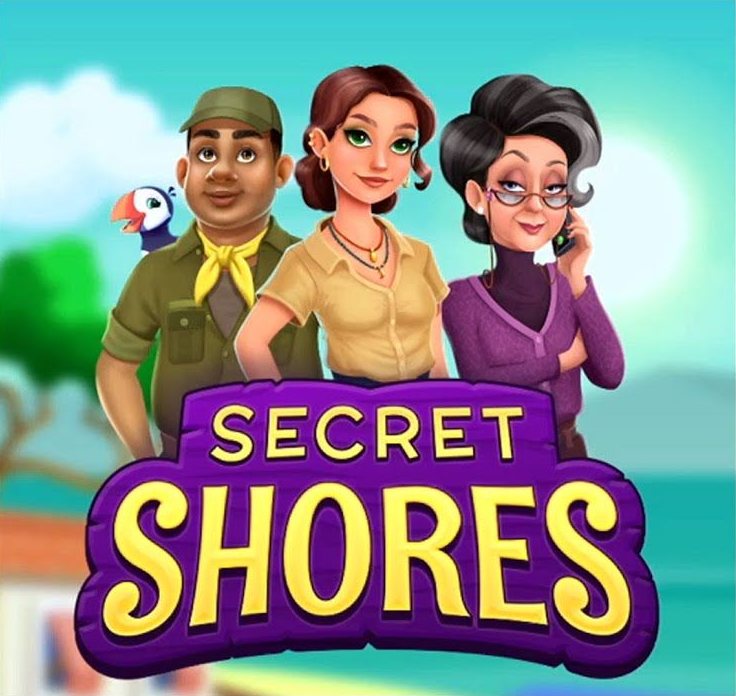
This article is a case study about the final game we developed and launched at Skunkworks, Secret Shores.
To this day, Secret Shores remains the biggest missed opportunity of my career. It is a game that was set up to grow rapidly by monetising heavier than its competitors and raising the bid ceiling of incumbents, beating all of the current leaders of the Merge 2 category to the punch by several months, if not years.
Alas, t’was never meant to be.
In lieu of that unrealised success, here is the backstory of how that game came into existence so that others might learn and succeed where we failed. This case study details the methodology and processes we developed to detect the opportunity, and how we used that data to position Secret Shores for success.
Part One: Skunkworks’ Lore
For context, Skunkworks was a mobile game studio set up to identify growth opportunities and act upon them rapidly. That core tenet of the studio set us up to ride turbulent air as a matter of course; we were not designed to run as a stable entity.
Our first game, Emma’s Kitchen, came from the realisation that the Cooking Game subgenre had evergreen attributes, and was also very stale. Meanwhile, hypercasual merge games such as Merge Town from Gram Games, were generating significant engagement and long sessions.
Games in the Cooking Game vertical met all of the tests we devised to detect a disruptable space.
- Revenue consolidation: The vast majority of the revenue within the sub genre (>70%) is split between 2 or fewer titles.
- Outdated feature sets: New entrants to the sub genre create a carbon copy of the previous successful title, with little to no innovation or modernisation of visuals or mechanics.
- Consistent Demand: Search volumes for key phrases remain consistent for a long period of time across multiple channels, including web and App Store searches.
- Outdated UA ops: Campaigns not centred around growth hacking or high engagement content strategies and campaign optimisation no longer appears to be a priority for the publisher.
- New titles grow fast: Despite a lack of innovation, players quickly flock to new titles within the subgenre, often temporarily boosting the overall revenue figures within that genre.
Emma’s Kitchen sadly failed to achieve the numbers we required for rapid growth, and as a result we killed it quickly and moved on to our second game, Merge Friends.
Merge Friends and the subsequent growth explosion of Skunkworks
There were no significant scientific findings behind the decision to develop Merge Friends, besides observing that another developer across town had entered the Merge space a bit earlier than us and had approached the mechanic in a better way. Merge Mansion, which later became the category leader by some margin, provided a proven model for us to replicate.
Within a few days of prototyping with the new mechanics, we knew we had something. We developed quickly, released quickly, and saw industry leading performance from our initial cohorts.
Merge Friends was released globally in the spring of 2021 and generated €1m of revenue within the first few weeks of release.
Unfortunately for us, Merge 2 was a nascent, hyper-competitive subgenre, and every studio watching it wanted to plant a flag before the position of leader was taken. Within a couple of months, twenty to thirty competing titles were bidding for the same audience on the same networks, and cost per install rose sharply as everyone raced to secure a share of the category.
Our underlying problem was monetisation depth, not marketing spend. Merge Friends generated roughly $4 in revenue per download. Merge Mansion, the Merge 2 category leader, generated roughly $8. That gap meant Merge Mansion could out bid Skunkworks for the same install and still keep a healthy margin: Merge Mansion simply had to accept a slightly lower ROAS by raising the bid ceiling on those trailing it.
Regardless, Merge Friends was the catalyst for Skunkworks that allowed us to hire some of the best game developers in Helsinki and raise more than €5.8m from incredible funds such as Creandum, LVP, and Moonfire. We also had a who’s-who of gaming angel investors on our cap table.
The ever increasing heat in the Merge 2 market forced us to rethink our approach to the category, and after a couple of cold starts we decided to go back to audience research with more purpose.
Part Two: Chasing The White Whale
Project Orca was born from the realisation that the market had evolved too quickly for us, and we had struggled to keep up. Merge Friends, while still retaining a huge well monetising audience, was unable to grow. CPIs were out of control, and we found ourselves having to refactor huge swathes of the client just to add new features and liveops events.
Instead of trying to out bid better monetising competitors, Skunkworks looked sideways at an adjacent subgenre. Merge 3 games like Merge Dragons and EverMerge were earning far more Revenue Per Download than any Merge 2 title, including the category leader:
Project Orca became the proving ground for a repeatable process the studio wanted to industrialise. The idea: perfecting a repeatable identify → analyse → validate → build cycle significantly mitigates the risk of making games in the first place and Project Orca was our first (and last) real attempt to achieve this.
Project Orca Phase 1: Identifying the highest spending player personas
Our research began with a qualitative gut check, then went looking for statistical proof: is the highest value player in a $4 RPD Merge 2 game the same person as the highest value player in a $38 RPD Merge 3 game?
We pulled data from Solsten across three separate audiences we had access to: the existing Merge Friends player base, a Merge 2 custom audience, and a Merge 3 custom audience.
Our observation from the available data was that the highest LTV persona was the same player in Merge Friends, in Merge 2 broadly, and in Merge 3. That correlation became the pivot point for the whole project: if the top value player was the same across a $4 RPD game, an $8 RPD game, and a $38 RPD game, the difference in what those games earned from her wasn’t about who she was. It was about what the games gave her to do.
Meet Justina Burkes.
Once we had identified the behavioural correlation of the highest spenders between the two subgenres, we set about mapping her needs and desires.
We found that:
- 45% of players matching this profile named matching and merging as their favourite game type overall.
- She wants to progress and feel productive. Achievement and visible improvement carry real motivational weight for her.
- She wants to be in control and creative in how she plays, not funneled down one path.
- She likes to collaborate with other players but does not want to depend on them.
- She’s drawn to “realistic fantasy,” things that are possible but generally out of reach day to day: travel, a garden of her own, rescuing animals.
- She’s ready to invest real time and money into a game that actually meets these needs.
The Mechanical Landscape
Our key observation was that the current Merge 2 metagame mechanics were falling short of what actually motivated Justina. Merge 3 games were already meeting that need, and monetising heavily from it.
Merge 3 pulled ahead sharply on thinking, collecting, discovering and customisation: the systems that reward a player for planning, exploring and expressing herself, not just tapping through content.
Skunkworks’ own data added a sharper edge to the picture: the players with the highest LTV in Merge 3 also show the highest engagement in Merge 2, spending roughly three times as much time in Merge 2 as in Merge 3, despite Merge 3 earning far more RPD. The implication was direct: this player was already playing Merge 2 games intensively. She just wasn’t being asked to spend like a Merge 3 player while doing so.
The hypothesis: Merge 2 games are easier to pick up and learn, but they don’t offer the depth or monetisation that Merge 3 offers. These high-LTV players are seeking something that didn’t yet exist in the Merge 2 market, and Skunkworks could be the first studio to identify and build it. A broadly appealing Merge 2 game, with real emphasis on metagame scalability and depth, could reach the top position not just of Merge 2, but of the merge genre as a whole.
Project Orca Phase Two: Moving From Persona To Proof
Once we had established the existence and spending behaviour of a high-value player across two subgenres, and mapped her motivations and intrinsic desires, we set about identifying the player fantasy that could best serve her.
We started by auditing the market, examining the themes and mechanics used by the games already popular with our target audience. This gave us a picture of what resonated, what had become formulaic, and where familiar player motivations might be served by a different kind of experience.
The team then ran a wide, structured brainstorm in three layers:
- Game concepts grounded in audience data, from home renovation and pets and vets to time travel and true crime.
- Settings and themes, with more than sixty possibilities, from island resorts and spas to ancient Rome and space stations.
- Player fantasies and motivations, with over sixty more, from solving crimes and tending a garden to rescuing lost creatures and building an empire.
We developed seventeen concepts in detail, assessing each against a consistent set of criteria: the central fantasy, how merging would serve it, how the game could expand over time, and its potential for progression and social play. We also recorded the drawbacks and production risks of each concept rather than treating every promising idea as equally viable.
The objective wasn’t simply to find a theme that sounded appealing. It was to identify a concept that translated the motivations of a demonstrably valuable audience into a compelling, extensible game, while offering room to outperform the experiences already available to them.
Project Orca Phase Three: Seventeen to One
We scored every theme against nine explicit criteria, rather than relying on instinct or personal preference: audience fit, concept fit, the centrality of human relationships or mystery, competitive positioning, branding and IP potential, natural opportunities for social features, scalability without creating a content treadmill, production workload relative to the team, and an overall assessment of strengths and weaknesses.
We grouped the seventeen concepts into six broad clusters, from Nature and Nature & Magic through to Modern and Other, then combined the strongest ideas within each cluster into three composite finalists. Each went through a full pitch, a criteria-by-criteria assessment and a moodboard.
- Island Paradise combined Island Exploration with Animal Sanctuary: rebuild your father’s storm-wrecked island resort, help its animals and residents, and uncover why he vanished.
- Shop of Wonders combined Charmed World with Book of Fables: keep a struggling city cafe alive while discovering that your friends are secretly supernatural.
- Queendom took a more direct route: claim the throne, rebuild your kingdom and unravel your parents’ disappearance.
Island Paradise emerged as the strongest candidate across almost every dimension. Renovation, gardening and animal care each had established appeal in Merge 2. The family mystery provided an emotional throughline, while the island setting offered natural opportunities for exploration and social features. Just as importantly, the world could be built from modular, tile-based assets, making the concept ambitious without demanding an unrealistic production workload from our team.
There was one significant caveat: we had evidence for the ingredients, but not yet for the combination. No amount of internal analysis and scoring could establish that this particular fantasy would resonate strongly enough to succeed in the market. That was the question we needed to answer next.
Project Orca Phase Four: Covert Testing With Real Players
It had become a running joke inside the studio that everything we did in Merge Friends was being badly copied by a much larger studio that may or may not rhyme with ScionShed. And since the market was so hot, we decided not to take the risk of having our fledgling game ripped off by a large entity with more resources than us before we’d had a chance to even build it. The entire testing programme ran under a shell publisher identity that couldn’t be traced back to Skunkworks, Hidden Spider Studios.
The truth is we literally rented use of a company entity off one of our developer’s mates for a small fee.
Moreover, we picked test markets and platforms that we could see were not being tracked by data aggregation platforms like Sensor Tower and AppMagic.
Full app-store screenshot sets were produced for each finalist, every variant carrying a different value proposition: explore the islands, meet the locals, solve a mystery, raise cute animals, build your own paradise. Art style, character race and gender, and environment were swapped across variants too, so the test measured which combination of fantasy, character and call to action actually converted.
Creative was tested for rapid audience reaction with real paid burst campaigns to measure IPM and CVR under the shell publisher’s account.
The full cycle, ideation, template development, creative production and testing, ran four to six weeks, entirely before any production code was written. By the time the team sat down to start coding, they knew the winning theme, value proposition, character and art direction, and roughly how the systems underneath needed to run.
Project Orca Phase Five: Developing the MVP
With the theme validated, the studio moved fast: from the first line of production code to a live MVP test in the Netherlands within eleven weeks.
A 54% Day-1 result from a first live build, following a validated theme and a persona built from cross-audience data, was a strong enough signal to keep going. For context, a fully mature title in this category testing on iOS in the US would typically need to clear something in the region of 60%+ Day-1 retention to be considered a genre leader. Landing in the 50s from a first live MVP test, four months after the research phase began, was read internally as confirmation that the underlying theme, persona targeting and value proposition were right, not as a finished number.
The technical build reinforced the same ambition. Project Orca was designed to be fully server-authoritative from the outset, meaning content could be delivered to the game without client updates and the entire live experience could be operated remotely by the live-ops team. The explicit target stated in the studio’s own materials: reach the ARPU of the highest-performing titles in the merge genre, and dominate the category.
Why this matters beyond games
When I look back at Project Orca, what stands out is how much of the work happened before we wrote a single line of code. We correlated player personas across different game audiences, identified a potential unit-economics gap, developed concepts against explicit criteria, and used paid marketing tests to investigate demand before committing to production. The individual techniques were useful, but their real value came from how they connected: each stage informed the next, narrowing the uncertainty around what we should build and why.
Today, much of this process runs considerably faster with AI. Research that once required substantial manual effort can be accelerated. We can explore more hypotheses, analyse more information, develop and compare more concepts, and move between stages with far less friction. The cost of getting from an initial idea to a well-researched, testable proposition is falling rapidly.
But the operating system does not need to change. The underlying discipline remains the same: identify a real opportunity, understand the people you intend to serve, develop a proposition that addresses their needs, test your assumptions against the market, and use the evidence to decide what deserves investment. AI changes the speed and scale at which we can run that process. It does not remove the need to run it.
And the need for validation is as strong as ever. If anything, the ability to build products faster makes it more important to know which products are worth building. When execution becomes cheaper, the bottleneck shifts towards judgement: choosing the right problem, recognising an underserved audience, and establishing whether there is genuine demand before committing resources. AI can help me investigate those questions faster, but it cannot make the questions go away.
AI is changing the economics of building products, making it possible to research, test and iterate on ideas at a pace that would have been difficult to imagine a few years ago. But faster execution does not make validation obsolete. It makes the cost of skipping it harder to justify.
The tools will change, and the time required to move from hypothesis to evidence will continue to shrink. The underlying principle remains the same: the earlier we can establish what people actually want, the better positioned we are to build products that succeed.
First published on Substack on 28 October 2026.